
Crawford Projected and Actual Release
Ohio’s official state field is Expected Release Date/Parole Eligibility Date. ODRC defines it as either a projected release date or a date pending parole consideration. Those two meanings are not the same. A projected date is the agency’s current calculation. A parole-eligibility date can mark when the Ohio Parole Board may consider release, not a date the Board must approve and not proof that the person walked out.
An actual Crawford County release is a completed custody movement. For a state prisoner, later ODRC status, Parole or Release Detail, and supervision start can confirm what followed. For a Crawford County Jail episode, the sheriff’s movement record supplies the physical departure, while the Municipal or Common Pleas docket supplies the legal order. A transfer to ODRC, another jail, USMS, or ICE means the person left one building while custody continued.
Note: A pretrial Crawford County detainee may have a bond path, but usually has no fixed computed release date.
Find Crawford County Projected Release Dates
Begin with the judgment entry, not an online sentence calculator. The court entry identifies the counts, effective sentence date, concurrent or consecutive terms, mandatory specifications, definite or indefinite structure, jail-time credit, and post-release-control notice. Then compare those facts with the correct custody system.
- Identify the custody branch. Determine whether the person is pretrial, serving a county-jail sentence, or committed to ODRC.
- Locate the Crawford County case. Use Municipal Court for misdemeanor, traffic, bond, and preliminary matters; use Common Pleas for the felony judgment.
- Search ODRC for a prison commitment. Use a full name or exact offender number and validate the match through county, docket, judge, date of birth, and offense.
- Read the exact combined field. Record “Expected Release Date/Parole Eligibility Date” exactly as displayed and note the observation date.
- Review the sentence detail. Compare effective sentence date, aggregate term, jail-time credit, hearing month, and latest Board result when applicable.
- Ask the responsible office about a conflict. Use the court entry for the order and ODRC Central Records for a disputed state calculation.
- Verify after the event. Check status, supervision start, release detail, and the originating agency’s movement record.
The broader Crawford County release-record search explains how to pair the court order with the sheriff record when the person never entered state prison.
Crawford ODRC Release Date Field
The ODRC Offender Search covers people incarcerated in an Ohio prison, under Department supervision, or judicially released. It is not a lookup for every person who passed through the Crawford County Jail. A county misdemeanant may have no ODRC record at all.
Search inputs include last name, first name, status, offender number, and next-parole-hearing month in YYYYMM. Offender numbers use an A, R, or W prefix and six digits; a shorter numeric portion may need a leading zero. Once a match is found, identity should be checked against committing county, docket, judge, and offense. The expected-date field must be read beside current status. An incarcerated status means the person has not yet been released even if a future date appears.
The official ODRC detail example shows the precise combined field used for Ohio release-date research.
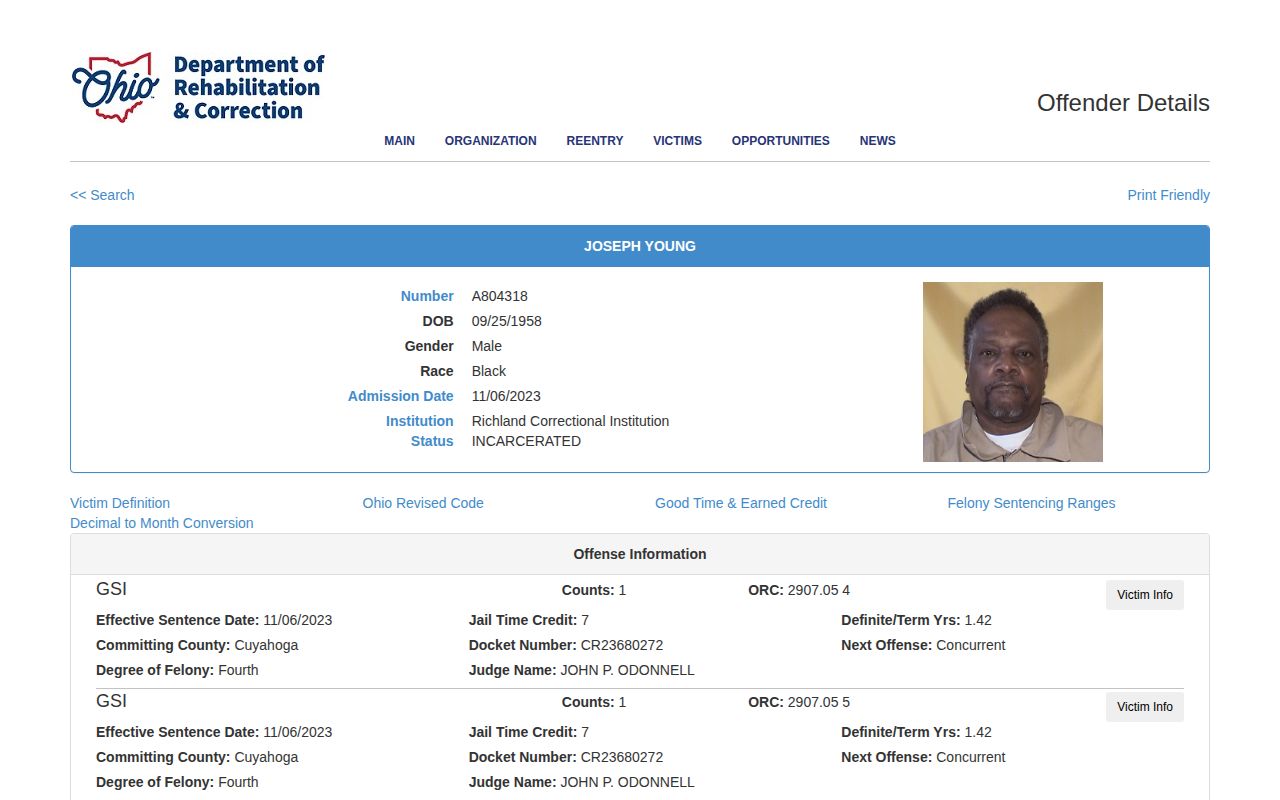
The image demonstrates the field, not a Crawford County case. Its wording is important because a parole date and a computed sentence date have different legal effects.
Crawford Release Date Calculation Rules
Release-date computation rests on several Ohio laws. ORC 2967.191 addresses jail-time credit for qualifying confinement before delivery to the institution. Use the credited number in the court or ODRC record. Do not count calendar days independently because time may apply to another case or sentence.
ORC 2967.193 governs earned credit. Credit is not automatic good behavior for every Ohio prisoner. Qualifying activities, rates, exclusions, caps, sentence-date rules, successful participation, and removal procedures all matter. Mandatory time cannot be reduced merely because a credit rate exists for another part of a term.
Other paths have their own rules. ORC 2967.13 governs parole eligibility, including sentence-specific life terms. Judicial release under ORC 2929.20 requires a court process and eligibility. Qualifying non-life indefinite sentences use the minimum and maximum framework in ORC 2967.271. Consecutive terms alter the aggregate sentence. Life without parole has no parole-eligibility date.
Note: The judgment entry and ODRC calculation control; a maximum possible credit is never a promised reduction.
What Changes Crawford Release Dates
A date may move because the legal inputs or the agency’s calculation changed. Some events change the term itself. Others change when the person can physically leave the current custodian. Keep the agency’s displayed label and the date it was observed so a later update is not mistaken for a false prior record.
| Factor | Possible effect | Where to verify |
|---|---|---|
| Jail-time credit | Changes credited confinement used in the sentence calculation | Judgment entry and ODRC Jail Time Credit field |
| Earned credit | May reduce eligible time; can be denied or removed under governing rules | ODRC record, current ORC 2967.193, and ODRC explanation |
| Mandatory or consecutive terms | Can prevent a credit reduction or move the aggregate date | Sentencing entry and aggregate-sentence display |
| Parole Board action | A grant, denial, or continuance can change the expected path | Hearing month, result label, Board record, and status |
| Judicial release | A court order may authorize an earlier prison exit with conditions | Common Pleas docket and ODRC release detail |
| Detainer or warrant | May cause transfer or continued custody after one term ends | Holding agency movement record and responsible court or agency |
| Record correction | A verified sentencing or data correction can revise the calculation | Court entry and ODRC Central Records |
A Board POA or projected-release date does not prove door-exit. Later status and supervision fields matter. Likewise, a court’s bond or release order does not prove that the Crawford County Jail completed processing or cleared all holds.
Resolve Crawford Release Date Conflicts
When the ODRC date and Crawford County judgment entry appear to conflict, do not choose the date that seems most intuitive. Record when each source was checked and transcribe the labels exactly. The sentencing court controls its order, while ODRC applies credit and statutory rules to administer the prison term. A later court entry, corrected jail-time credit, consecutive sentence, or updated Board action may explain the difference.
For a state-record question, send ODRC Central Records the offender number, Crawford County docket, precise field in dispute, and the court entry that supports the concern. Central Records receives mail at P.O. Box 430, Columbus, OH 43216. Ask for clarification or correction of an existing field rather than submitting a home-made calculation as the expected result.
For a local sentence, contact the correct clerk and the Crawford County Jail. Municipal Court handles its misdemeanor, traffic, bond, and preliminary matters. Common Pleas holds the felony judgment. A certified or verified court entry establishes what the judge ordered; the jail movement record establishes when that custodian acted. If the sources still do not identify a destination, describe the person only as having left that facility until transfer or community release is confirmed.
Note: Preserve older observations with their check dates because a revised official date does not erase what the system previously displayed.
Crawford County Jail Release Dates
State-prison formulas should not be applied to a county-jail sentence. For a Crawford County Jail term, obtain the commitment entry, sentence start, jail-time credit, and any applicable local or statutory rule directly from the court and jail. No official source in the Crawford County research publishes a county good-time schedule, automatic Friday or weekend adjustment, or daily release-processing time.
Call the Crawford County Jail at 419-562-7906 and ask about the identified booking. A narrow records request can seek the existing release or movement entry, date and time, authority or code, and destination. The sheriff operates the jail around the clock, but the public sources do not establish separate records-unit hours or a date-computation desk.
For court records, Municipal Court’s online data may lag by at least a day or longer. Common Pleas currently carries a stale-search notice during software work. When an exact Crawford County release decision matters, contact the clerk for verified information rather than treating the screen as a final, current answer.
Crawford Work Release Is Custody
The Sheriff’s 2025 Annual Report discusses work-release and trustee inmates returning to the jail and undergoing body scanning. That local detail establishes an important boundary: work release is an authorized movement privilege while custody continues. Seeing a person outside the facility for work does not establish final release, discharge, or the end of the jail sentence.
Confirm the actual end of custody with the jail movement record and the sentencing court. A roster observation can lag, and family observation cannot reveal a legal status or another hold. No published Crawford County source supplies a separate work-release completion calendar.
Crawford Parole Dates Need Board Review
For parole-eligible sentences, the next hearing month and the latest result can explain why a date is not a guaranteed release. ODRC’s public search accepts a next-hearing month in YYYYMM. Individual records may show “Next Parole Board Hearing/Review Month” and “Latest Parole Board Hearing/Review Type & Results.” Observed labels include CONTINUED/PAROLE, FULL BOARD/PAROLE, and TC REVIEW/TC DENIED.
A grant or POA date reflects Board action. It does not prove physical departure. After the expected event, read the ODRC status, supervision start, APA office, and Parole or Release Detail. A person under APA SUPERVISION has left prison but remains under state authority.
Confirm Crawford County Actual Release
Record the projected date with its exact label and observation date. On or after that date, check the responsible agency rather than assuming release occurred. For ODRC, a status change, supervision start, and release detail are more probative than the old forecast. For the Crawford County Jail, request the physical movement record and compare it with the court order.
Ohio VINE can send custody-change alerts for participating county-jail and ODRC records, but it is a notification channel rather than certified proof. Registration is most useful before the event. The Crawford County VINELink Check explains agency matching, event labels, and confirmation steps.
Note: Transfer, judicial release, parole, post-release control, and final discharge are distinct outcomes and should retain their exact record labels.